
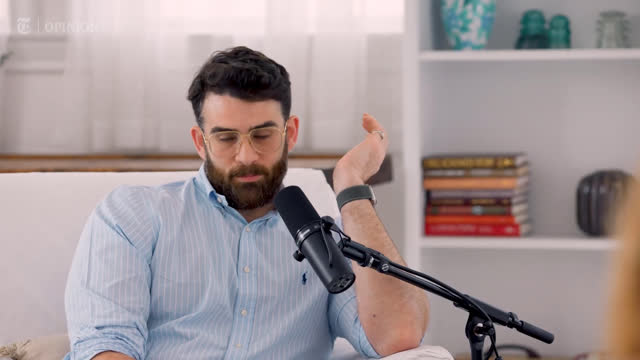
 0:56Hasan Supports 'Microlooting' Because Companies Factor It In
Loading interactive controls…
ARCHIVE VIDEO / IC–061
Hasan Supports 'Microlooting' Because Companies Factor It In
Recording
Enable JavaScript to play the recording here. The source links and transcript remain available.
0:56Hasan Supports 'Microlooting' Because Companies Factor It InSources
- Source link supplied with the archive ↗www.youtube.com · imported reference
https://www.youtube.com/watch?v=_bPcz1DAtrE
Transcript 178 passages
Times refer to the stored video, not the original livestream. Select a timestamp to play that passage. Outside the excerpt, playback switches to context; passages beyond the ±5-minute window use a separate full-recording mode.
178 passages.
I forgot for lemons, and on several occasions, I was like,
"I'm just gonna go back grab those for lemons and get the hell out."
- You should go to prison.
- I know, you think they're gonna ban me?
- They should throw you in jail.
- But I didn't feel bad about it at all.
- I'm proposing a new term, micro-looting.
- I started going into the grocery store.
I would pick up the thing and I wanted it, and then I would go.
- It's a survival technique.
Gotta eat a lick, gotta steal the eater pain for that, right?
- No, babe, food is a human right.
- People are taking small things from big corporations,
and they're feeling justified.
- Like, look, everyone's shoplifting from Whole Foods
when you're shopping there.
- But you're not gonna steal from a deli like that.
- But Whole Foods, fuck Whole Foods,
fuck basil, fuck Amazon, all that.
- We should be rioting, but we're tired,
so I'm gonna take these bagels.
- But isn't a slippery slope?
What's going on with our moral code?
- To find out, I'm talking to political commentator Hassan Piker
and New Yorker writer, Jaya Tolentino.
- Thank you both so much for being here with me today
to talk about this.
Hi, Jaya.
- Hi.
- Hi, Hassan.
- Hi.
- I wanna start with a little exercise,
just about our own morals.
Would you share your Netflix password?
- I do.
- I also do, well, I--
- With anyone.
- For the longest time, I actually had someone else's
Netflix password. That was my primary access to Netflix.
- And now you share your own.
- Yeah.
- Would you get around to pay while I'm an article
you're trying to read?
- Do it every day on my stream every day.
- Yeah, but I support it when people do it for my own work.
I say, go off.
Use the way back machine.
- Would you pirate music from an indie band?
- Is it 2005 and I'm using lime wire?
Because yes.
- I feel like every millennial has at some point.
- I feel like fundamentally Spotify is kind of like
deleterious to the musician livelihood and I use that.
But then I go to the shows.
- Yeah, no, I'm pro piracy all the way.
Like across the board, would you pirate a car?
Yes, you know, if you could.
If one could pirate a car.
- If it was just the classic thing back in the day.
The government-funded anti-piracy initiatives would be like,
would you steal a car?
- Yeah, sure. If I could get away with it.
If it was as easy as you know, pirating IP, I would do it.
- Would you dine and dash from your local diner?
- Never.
- Never, tip 35 percent.
Mike's, come on.
- No, I wouldn't do that.
And if I saw somebody doing that, I'd probably pay for their meal.
- Would you steal a book from the library?
- Never.
- No.
- What do you steal from the Louvre?
- Yes.
- I would not be logistically capable of executing such a fact.
But would I cheer on every news story of people that I see doing it?
Absolutely, absolutely.
- Yeah, I think it's cool.
We got to get back to cool crimes like that.
Like, you know, bank robberies, right?
Stealing priceless artifacts.
Things of that nature.
I feel like that's way cooler than the 7,000th new cryptocurrency scheme
that people are engaging in.
- Would you steal from Whole Foods?
- You want to go first?
- Yes.
And I have under very specific circumstances.
I think that stealing from a big bookstore,
I'll just state my platform.
It's neither very significant as a moral, wrong,
nor is it significant in any way as protest or direct action.
But I did steal from Whole Foods on several occasions.
I've been involved in a neighborhood mutual aid group since 2021.
And so every week I would go get groceries for Miss Nancy,
my now family friend who lived nearby and she wanted to go to Whole Foods.
She wanted food from Whole Foods.
So I was like, okay, great.
And so I'd be getting Miss Nancy all her groceries and then I would finish and be like,
oh my god, four lemons.
I forgot four lemons.
And on several occasions, I was like,
I'm just going to go back grab those four lemons and get the hell out.
- You should go to prison.
- I know, you think they're going to ban me?
- They should ban me.
- They should throw you in jail.
- But I didn't feel bad about it at all.
- And I was part of it because of how you feel about Whole Foods as a corporation.
- Yeah, it already felt like a bit of a compromise.
Like at the time I was like, I had not you been to Whole Foods.
I had sort of, I had a bit more sort of consumer discipline
about where I was spending my money then.
And I already felt like I was in the hole even by shopping there.
And it certainly felt in a utilitarian sense.
I was like, this is not a big deal.
- Well, all right guys.
- I'm pro stealing from big corporations
because they they steal quite a bit more from their own workers.
However, one thing that might even help your ethical dilemma
is the fact that the automated process that they design, these companies know will increase shrink.
Right? So it's actually factored in.
The lemons that you stole are factored into the bottom line of these mega corporations
regardless. And they still end up having increased profit margins because they no longer have to pay
the cashiers that they used to hire as opposed to this automated system.
Knowing full well that people are still going to be able to steal,
still steal a lot more efficiently as a matter of fact through the automated process.
- Totally. Well, also I was looking things like it and shrinkage is a roughly equal internally
as externally. Like they expect it from their employees that they are sort of disenfranchising constantly.
- But what about the argument that if everyone just starts stealing wantonly
from the self-checkout machines, hopeful Whole Foods will eventually raise the prices?
- Yeah. Chaos. Full chaos. Let's go. I mean, look, I'm in favor. I'm in favor of fast and free buses
and also government-owned storefronts. And two of those policies, the mayor of this beautiful
cities is currently working on. - Would you encourage stealing in the same way
from a Mambani run city-owned grocery store with other prices? And why?
- I would not, because I feel like that's taxpayer funded and the prices are this union labor
and the prices are also adjusted regardless. - I think that hypothetical is interesting,
because if you look at it from a categorical imperative type thing, what if everybody did this?
The converse is like, oh, what if every major grocery chain stole from workers and consumers?
And that is basically true, right? Like, it's interesting. Like, I think it speaks to the thing where
a kind of harm committed by the individual strangely continually draws more
higher than the same harm being committed by a structure. And so, I mean, and so I kind of am inclined
towards this. It's like, everyone try it. See what happens. - By the way, ironically enough,
I don't personally do it. I never do it when I was younger. I stole some Pokemon cards from a friend
and my father punished me and it was such a harrowing experience that I've, like, I literally can't even
steal like a candy bar. When we were in college, a lot of my, a lot of my friends used to love doing that.
You know, getting drunk, going to the gas station, five finger discount, I would never participate in it.
And I still can't to this day participate in it. I'm just saying that I personally don't really care.
If someone needs the food, they should absolutely steal it. - There's one thing that's like stealing when
you're a teenager and you want the adrenaline rush and part of it is about testing the rules and
getting away with something. But I feel like what I'm seeing on TikTok and social media is people
saying that they're stealing from Whole Foods, not just for the thrill of it, but out of a feeling of
anger and moral justification because the rich don't play by the rules. So why should I? And
Jeff Bezos has too much money, he's a billionaire. So I should I have to pay for again and call the
Cautos. My friends and I have started calling this micro-looting because it has a, like,
slight political valence, the theft as opposed to just a thrill of getting away with something.
Have you noticed this around you online? Have you noticed more people talking about stealing in this
way? - I mean, I have, I have not seen people talking about micro-looting or such, you know, whatever
action that this is online. But I think, I mean, it kind of speaks to an attenuation of the tactical
language of direct action, you know what I mean? Like, it's like, like, it's like, it doesn't work for
me as a form of direct action because it's, it's concealed, right? Like, any successful direct action
history has to be ostentatious, has to make itself known as ideally collective and this is sort of
necessarily individual and hidden. But I'm like, oh, great. Let's think of ways to, like, let's take
this energy and let's move it into some other thing. Like, I think it's, I think it's great that
the valence of property is kind of on the table as something to be toyed with in terms of direct action.
I feel like we've forgotten there is a long and storied history of sabotage and sort of engagement
with property destruction, even, which is abhorrent to people. I mean, yeah, you remember in 2020,
the like Gucci Chanel stuff in Soho when that was looted. Well, then my PD is investigating a robbery
pattern targeting high and clothing boutiques in Soho. Later, it's happening Tuesday at the Chanel
on Spring Street. That looms so much larger in many sort of Bloomberg liberals imaginations as
profoundly more violent in some ways than the original action being protested, right? And I find
that really interesting. Yeah. I mean, I was, I was thinking about the Boston Tea Party as part of
like that's a political destruction of property. And yet right now it feels like I agree with you,
the looting around the 2020 protests was such a huge talking point. I made people so uncomfortable.
And I'm curious why, like, what do you think the root of that is? I was thinking, you know,
that thieves are actually quite highly valorized and narrative, you know? I mean, Aladdin,
famously. Robyn Hood, yeah. We understand it's, it's well within the collective consciousness
that stealing for need or